
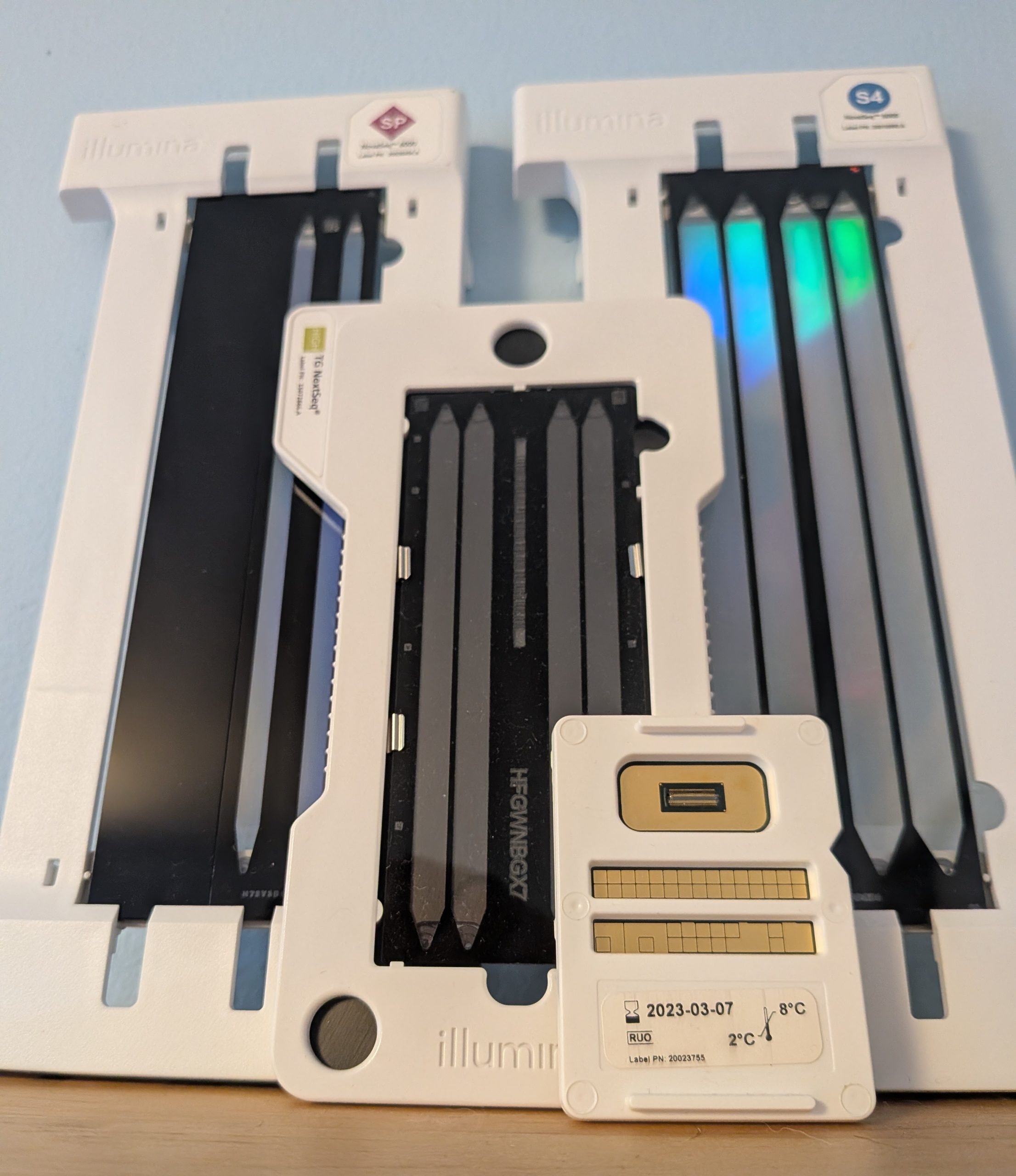
“How many samples can I fit on my flow cell?”
“What flow cell should I use for my project?”
“How many reads or how much coverage do I need?”
The question came up frequently while I was at Illumina, and the answers were rarely straightforward. Misunderstanding this number can lead to either over- or under- sequencing, both costly mistakes.
This is partly because there are some commonly used terms that can be confusing:
Sequencing depth: The number of times a specific nucleotide was read during the sequencing process. Higher depth = Higher confidence.
Sequencing Coverage: Typically expressed as a percentage, the amount of the genome or region of interest that has been sequenced. Eg, “95% coverage” refers to 95% of the genome being read at least once.
Confusingly, Illumina uses the term slightly differently than others:
Illumina definition of Sequencing Coverage: Closer related to depth, referring to the number a times a particular reference was covered/sequenced. Eg, typical recommendations for human WGS is 30x coverage, so each nucleotide in the genome would be covered on average 30 times. Often used interchangeably with sequencing depth.
Read more about Illumina’s definitions on their website here.
Note that there are a few things in those definitions worth pointing out. Most DNA sequencing projects refer to coverage required, while most RNA projects will refer to the number of reads required, expressed per sample.
How much coverage or how many reads do I need?
This is highly project dependent. A typical recommendation for a whole genome sequencing application of the human genome will be between 30-50x coverage, while targeted panels may require higher amounts. A quick RNA-Seq gene expression profile may be in the range of 5-25million reads/sample, whereas the assembly of a novel transcriptome may require 100-200million reads/sample. If you don’t know this answer, you need to start by figuring that out.
Okay, so how many samples can I fit?
Now that we have a base understanding of what things are, how they are interacting with each other is just a matter of basic algebra with the Lander/Waterman equation. The full paper can be read here and a technical note by Illumina is available here. The equation shows the relationship between coverage, genome size, read length, number of reads, and number of samples.
C=LN/G
where:
C = Coverage
L = Total Read Length
N = Number of reads
G = Haploid genome size or targeted region (in the case of enrichment panels)
Based off this you can see that as the number of reads or the read length increases, the coverage increases. Conversely, as the haploid genome size increases, the coverage will decrease.
Not included in this version of the equation is the number of samples, which can be taken into consideration by multiplying it by the genome size to get the following:
C = LN/GS
where:
S = Number of Samples
This equation notably does not account for the realities of the lab – things like error and duplicate rates, how well the instrument is loaded, the overall quality of the library, if you’re mixing library types with different genome sizes or different required read lengths.
If you use the Sequencing Coverage Calculator provided by Illumina, you’ll see a default duplicate rate of about 2%, depending on the application you chose. This effectively adds 2% to your total reads required.
An Example
You have some honeybees you want to perform WGS on. The average honeybee genome is between 225-260Mb (megabases) – we’ll pick 250Mb as a midpoint. You have access to an Illumina MiSeq i100 in your lab, and want to know if you can get away with the smallest 5M flow cell, or if you’ll need to go a size up to the 25M. You want to just do some basic population screening, so you’d like to aim for about 20x coverage.
Let’s do some math
Given the equation:
C = LN/GS
We can reconfigure this around to find the number of samples:
S = LN/GC
where:
S = number of samples (what we’re solving for)
L = total read length (Your library prep kit recommends 2x150bp, which would be a total read length of 300bp.)
N = Number of reads (The 5M flow cell is 5 million reads, the 25M 25 million reads. These specifications are available on the specification page of the instrument)
G = haploid genome size (250Mb)
C = coverage (20x)
So putting that together, for the 5M flow cell you can fit:
S = (300x5M)/(250Mbx20)
S = 0.3
This means you would not get your 20x coverage for even 1 sample on a 5M flow cell. We can quickly figure out what kind of coverage you would get for 1 sample:
C = LN/G
C = (300x5M)/(250Mb)
C = 6
6x Coverage.
6x coverage is barely sufficient for making a quick feasibility check, let alone the population screening you’re looking for.
If we instead try the 25M flow cell, which has an output of 25million reads, or 5x the 5M, we can multiply that 0.3 samples by 5, to get 1.5 – so you could fit 1.5 samples on your 25M flow cell. Realistically this means you’d fit 1 sample with about 30x coverage, or two samples with 15x coverage.
Again, though, consider that this is math in a vacuum. Maybe your run is overloaded due to poor quantification (a very common cause of run failure), lowering the number of usable reads. Maybe it’s underloaded, increasing your duplicate rate, and missing the full capacity of the flow cell. Either way, you’ve now missed your required coverage, and now you have to resequence.
The equation may be straightforward, but the application can be tricky. Making sure your run gets you the data you need is where the experience comes in.